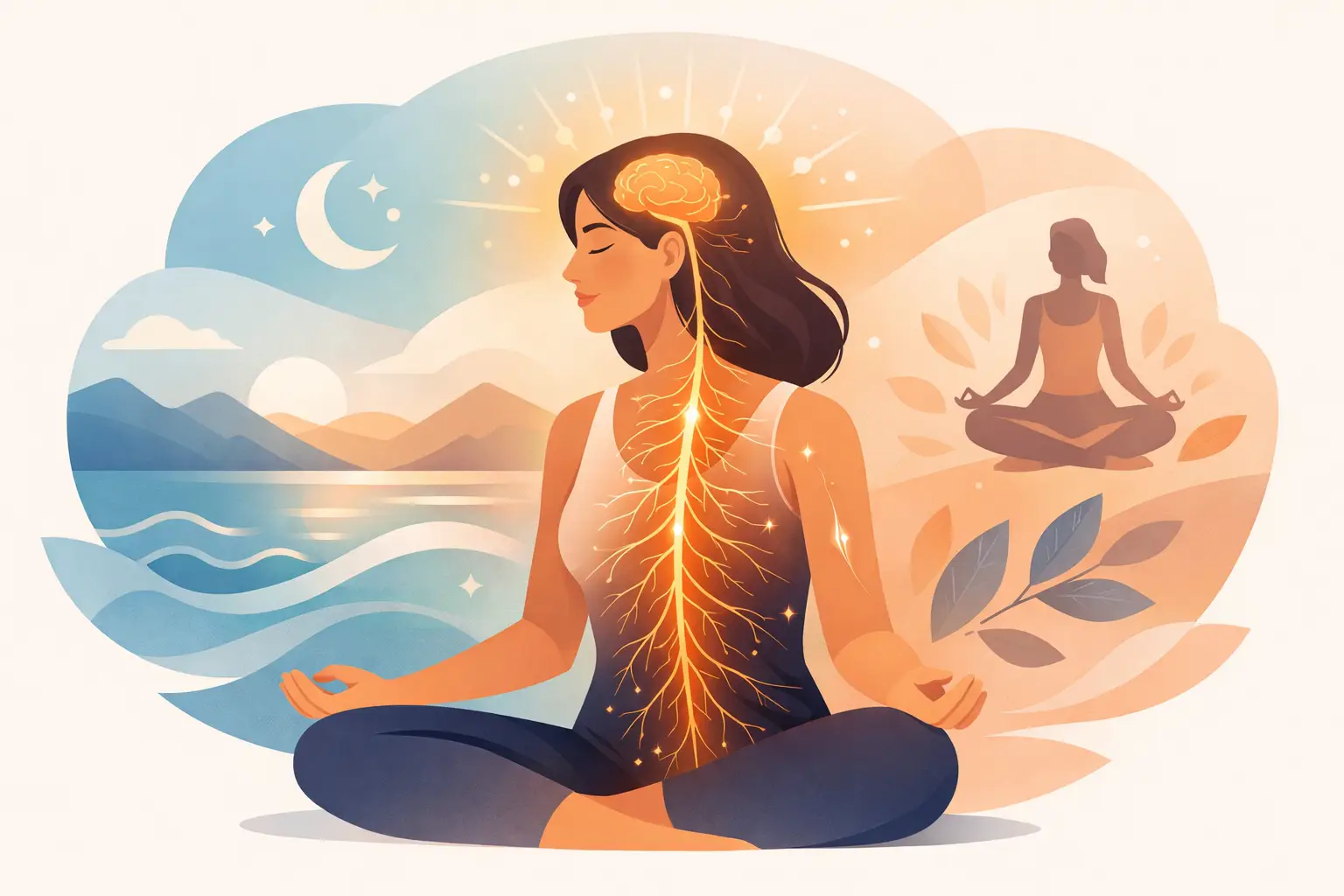
There is a moment many women know well: you finally stop moving, the house is quiet, the meeting is over, the child is asleep, and yet your body is still braced as if something is about to happen. Your mind calls it stress. Your body calls it survival. A nervous system reset for women begins there - not with force, not with more discipline, but with the sacred work of teaching the body that it is safe to soften.
This matters because women are often asked to be available long after their biology has asked for repair. To hold emotional weight, to perform through hormonal changes, to stay productive while under-rested, overexposed, and touch-deprived. The result is not only fatigue. It can look like fragmented sleep, a short fuse, low desire, anxiety that hums beneath the surface, afternoon crashes, jaw tension, bloating, numbness, and the strange ache of feeling disconnected from your own body.
A reset is not a hack. It is a return.
What a nervous system reset for women really means
The nervous system is your body’s listening field. It tracks pace, pressure, noise, conflict, blood sugar swings, hormones, light exposure, loneliness, and whether you have had enough rest, enough touch, enough beauty, enough pause. When the system stays activated for too long, the body begins to organize around defense.
For women, that pattern is rarely just mental. It is endocrine, relational, sensory, and cyclical. Stress can shift sleep, digestion, libido, skin, focus, and menstrual rhythm. Perimenopause and postpartum seasons can intensify this further. So can grief, caregiving, travel, trauma history, and high-achievement environments that reward override.
That is why a real reset does not start with asking, How do I push through better? It begins with a different question: What conditions help my body trust this moment?
Sometimes that means stillness. Sometimes it means movement before stillness is possible. Sometimes it means less stimulation. Sometimes it means the right kind of sensory input - warmth, scent, therapeutic touch, low light, a slower voice, steady breath, music that lowers the pulse instead of raising it. Regulation is not one-size-fits-all. It is deeply personal.
Why women often need a different approach
Much of mainstream biohacking treats the body like a machine to optimize. Track more. measure more. correct more. For some women, data can be supportive. For many others, especially when already depleted, it becomes one more layer of vigilance.
The female body often responds more profoundly to relationship, rhythm, and felt safety than to intensity. This is not softness as a lesser path. It is precision. The nervous system is shaped by cues, and cues are often sensory before they are cognitive.
A woman may know she is safe and still not feel safe. That gap matters. You cannot shame your way into regulation. You cannot schedule restoration so tightly that it becomes another performance. And you cannot heal chronic activation while living in constant sensory excess.
A more embodied approach honors three truths at once. The body needs consistency. The body needs pleasure. The body needs enough slowness to register both.
The first signs your body is asking for a reset
Women rarely wait for a breakdown. More often, they normalize the early warnings. Feeling wired and tired. Waking at 3 a.m. with a racing mind. Needing caffeine to feel alive and wine to feel calm. Snapping at people you love, then feeling ashamed. Losing access to hunger cues, pleasure, sexual desire, or deep sleep. Feeling strangely flat even while doing all the “right” things.
These are not moral failures. They are messages.
The body whispers before it shouts. If you listen early, the reset can be gentler. If you have ignored it for years, the process may take longer. Both are valid.
A body-first nervous system reset for women
The most effective reset practices are often beautifully simple. Their power comes from repetition, not novelty.
Begin with sensory downshifting
Your body cannot settle while every input says urgency. Start by changing the environment before trying to change your thoughts. Lower harsh lighting in the evening. Reduce background noise. Step away from relentless scrolling. Let warmth touch the skin - a bath, a shower, a heated wrap, bare feet on sun-warmed stone, hands around a cup of tea. Scent can help too, especially if it becomes a ritual cue that the day is closing.
This is not indulgence for its own sake. It is nervous system language.
Let breath be an invitation, not a command
Breathwork helps, but only when it does not become another demand. For some women, aggressive breathing practices can feel activating rather than calming. Begin with lengthening the exhale slightly and softening the jaw, tongue, and pelvic floor. Rest one hand on the heart and one on the lower belly. Give the body evidence that there is no immediate threat.
If closing your eyes feels edgy, keep them open. If silence feels loud, add soft music. Regulation works best when it meets you where you are.
Use rhythm to restore trust
The nervous system loves predictability. Not rigidity, but rhythm. Waking and eating at similar times. Morning light within the first hour of waking. Evenings that signal closure instead of continued stimulation. A bedtime sequence repeated often enough that the body begins to anticipate rest.
This matters more than people think. A beautiful ritual practiced three times a week with devotion can regulate more deeply than a dozen trendy interventions used inconsistently.
Reintroduce pleasure without agenda
Pleasure is often misunderstood as reward. In truth, it is information. It tells the body that life contains more than threat, duty, and output. For women with chronic activation, pleasure may need to be rebuilt slowly. Through texture. Through slow meals. Through self-massage with oil. Through music that opens the chest. Through affectionate touch without demand. Through sensuality that belongs first to self, not performance.
This is one of the reasons holy·stic biohacking centers ritual and therapeutic touch. When pleasure is honored as medicine, the body remembers how to receive.
Move in ways that discharge, not deplete
Exercise can support regulation, but intensity is not always the answer. If you are already running on stress hormones, more stress may sharpen the edge rather than soften it. Walking, mobility work, restorative yoga, rebounding, dancing, swimming, and strength training with adequate recovery can all help. It depends on your season, sleep, cycle, and baseline exhaustion.
The question is simple: after movement, do you feel more inhabited or more depleted?
Protect blood sugar and mineral balance
A dysregulated nervous system is often aggravated by undernourishment. Skipping meals, living on stimulants, or eating in a rush can keep the body in alarm. Many women feel more stable when meals are regular, protein-rich, and supported by hydration and mineral intake. This is especially true in stressful seasons, during hormonal transitions, or after poor sleep.
No ritual can fully compensate for a body that does not feel fed.
What gets in the way of real reset
The biggest obstacle is often not lack of knowledge. It is mistrust of rest.
Many women have been praised for functioning while flooded. They know how to lead, provide, soothe, achieve, and anticipate. Slowness can feel foreign. Pleasure can bring guilt. Support can feel harder to receive than exhaustion.
There is also the temptation to turn healing into another metric. How many minutes did I meditate? How low is my heart rate? Why am I not calm yet?
But nervous system work is rarely linear. Some days your body opens quickly. Some days it resists because it has learned that vigilance keeps life together. Compassion is part of the method, not a sentimental extra.
When a reset needs deeper support
If you have persistent panic, trauma symptoms, severe insomnia, chronic pain, burnout, or a history of dissociation, self-guided rituals may not be enough on their own. They can still be valuable, but deeper support may be needed. The most skillful care is never either clinical or sacred. It can be both.
That is the quiet maturity of this work. A nervous system reset for women is not about romanticizing collapse or pretending a candle can solve structural stress. It is about restoring the body’s capacity to receive care while also making honest changes to pace, boundaries, nourishment, environment, and relationships.
Your body is not asking to be optimized into submission. It is asking to be listened to with more reverence than force. Start there. Dim the lights. Lengthen the exhale. Place one hand where you most often hold tension. Offer your system one clear message, again and again: you do not have to brace for life in every moment.
If you feel ready to practise this with guidance, you can write to us and tell us where you are starting from, or explore the holy·stic biohacking paths and courses, designed to turn these gestures into a daily practice.